
Going to school in the wilderness
•Minneota Biology students get lessons on nature and wildlife
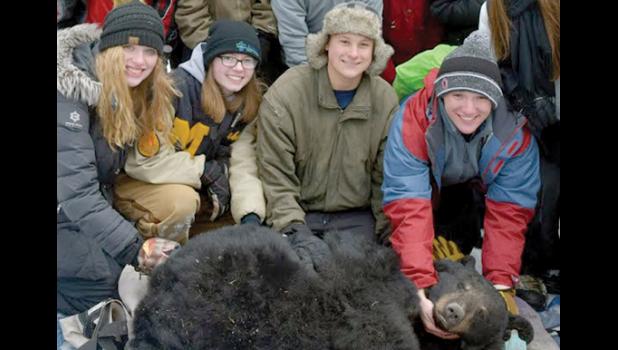
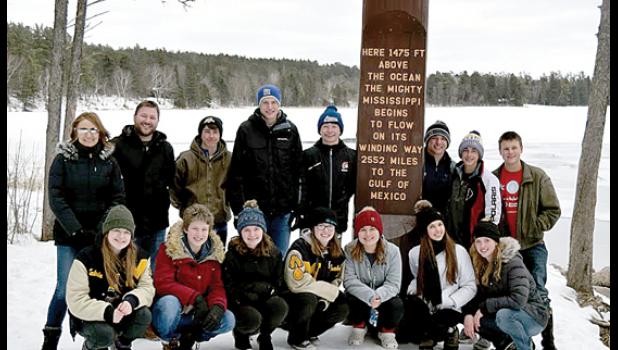
A valuable learning experience for a high school student doesn’t necessarily mean sitting at a desk with an instructor giving lessons in the front of the room. For Kent Williams’ sophomore Biology students, the classroom involved being outdoors in the northern Minnesota woods recently in order to experience nature. And one of those close-up experiences involved the students being able to watch DNR officials study a black bear and her cubs. Williams grew up in the wilderness of northern Minnesota amid many species of wildlife. So it seemed only natural that he shared his experiences with his class. “It was really a lot of fun and we learned a lot,” said Katie Walerius. “I’d go again if I had the chance,” said Carter Schuelke. “It was educational and fun.” Williams and paraprofessional Zita Miskiniene each drove a school van with students on the field trip. One of the most inspiring and educational experiences the 13 students encountered during their three-day trip (March 14-16) to the Northwoods involved the black bear. “The most educational thing for me was learning about the bear,” said Katie Walerius. The students were on hand to watch the removal of the 245-pound mother bear and her three six-week-old cubs from the den. The cubs weighed around five pounds apiece. “Three workers put the cubs under their coat to keep them warm,” Schuelke told. “They brought the cubs over to us and we could pet them if we wanted to.” Many of the students, including Walerius and Schuelke, accepted the offer. “When I touched one of the claws of a cub, he sort of grabbed my hand,” Schuelke laughed. “I wasn’t sure what to expect, but it didn’t hurt or anything.” The DNR officials were careful not to injure or disrupt the tranquilized mother bear when moving her from the den in order to study and weigh her. “They made sure to put the mother back in the den in the same position that they took her out,” explained Schuelke. “They even repositioned her three times to make sure it was just right.” “And then they put the cubs back in the den next to the mother and they cuddled up against her right away,” Walerius said. Williams was practically raised in the woods, where his thirst for nature was first developed. Williams was born in Indiana where his father, John, was employed with the Indiana Department of Natural Resources. After living there for six years, the Williams family moved to northern Minnesota when John accepted a job as an assistant manager of the Thief Lake Wildlife Management Area. “This area includes six Wildlife Management Areas that total more than 116,000 acres,” Williams explained. Williams’ father then accepted a similar position in Thief River Falls; not far from Thief Lake. There, Kent spent seven years until graduating from Marshall County Central High School in 2004. “My parents bought a farm which again was filled with many types of wildlife,” he said. “Here, I spent most of my time hunting, fishing and being outdoors.” “I spent many years moving around Northwest Minnesota. But where I call home is a small town called Viking, MN; a fairly rural area. Wildlife such as deer, moose, elk, wolf and bear were an everyday occurrence growing up in such a place. Thief Lake is primarily known for its waterfowl production." Big game moose and black bear could also be found in that area. “If you wanted to see a moose, you simply had to hop in the car and drive a few miles,” he told. “It was a guarantee that there would be one in a field somewhere.”
“At night, I could go outside and howl to the timber wolves, which would, in return, howl back. I could really get them going after a while.
One of the two major elk herds that are located in Minnesota would run around Thief Lake. I had no idea that I was growing up in such a rare place of North America. I thought everyone was experiencing similar things.” After graduating from high school, Williams attended Minnesota State University, Moorhead.
After five years there, he double-majored; receiving a B.A. in Biology and a B.S. in Life Science Education.
He has been teaching Life Sciences in Minneota since 2010. And Williams wanted his students the opportunity to experience those things he was fortunate to experience in the outdoors.
“We were extremely fortunate to be able to go on this field trip,” he said.
“I was put in contact with Andrew Tri, who is one of the leading bear biologist researchers for the state of Minnesota.”
Williams then sent Tri an email to see if it would be possible for his students to observe one of his bear studies. Tri agreed that it would be a valuable experience for the students.
Williams was allowed a limited number of students that could attend the field trip. Each student was required to write a one-page paper explaining why they wanted to attend this field trip. They also had to request a letter of recommendation from someone within the community; excluding a teacher.
“The students that went on this trip really wanted to go,” Williams said. “They will be presenting to the school board describing this trip.”
Even Williams, who lived among the wildlife for his entire childhood, learned something new by taking this trip. “This was the first time I have ever observed a black bear study and certainly the first time that I have been able to take students to such a study,” Williams said.
Williams had hoped his students involved in this field trip would gain knowledge from a scientific level on how real research data is taken among wildlife from researchers and DNR officials.
“Early in the year, my biology students needed to read, analyze, and present on wildlife population studies written by researchers like the ones we were able to meet from the Minnesota DNR on this study,” Williams said.
“This was an opportunity to see it first-hand, which makes it more real to them.” “I know that many of these students have never been that far north. Many have never seen the forested ecosystems of Northern Minnesota and hardly any have ever seen a bear in the wild before.”
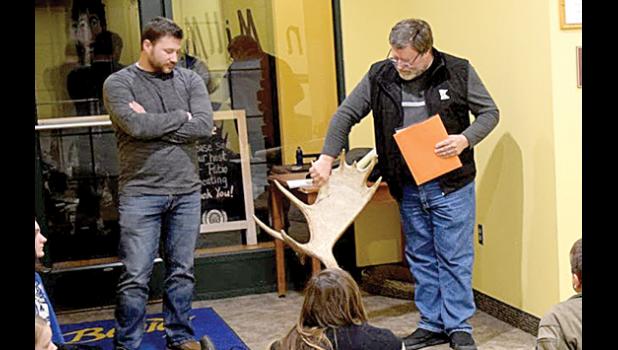
Besides observing a bear research team, the students also were able to go snowshoeing at Itasca State Park and learn about forest ecosystems native to the state with DNR naturalist Sandra Lichter.
“She was an incredible guide,” said Williams. “She was so knowledgeable about not only the ecosystem, but also the history of Itasca State Park.”
And Williams’ father, now a Regional Wildlife Manager of Northwest Minnesota, met the students and talked with them about his experiences and what it’s like to work in wildlife management.
“Listening to Mr. Williams’ dad was the most educational for me,” said Schuelke.
“He was really interesting.” The trip was school-funded, including the overnight stay in cabins.
Students had a combination of making their own food in a kitchen at the cabin, and the school providing one meal per day at a restaurant.
“A huge thank you needs to go to Mr. Frie, who championed the idea of us going on such a trip, and to Mr. Deitte, who was able to find the funds for us to go,” Williams said.
“They are trying to get students hands-on experience and this was as hands-on as it gets.”