weed

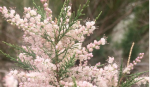
A saltcedar infestation.

Saltcedar (Tamarix ssp.) or tamarisk were introduced to the United States in 1823 on the East Coast. They were originally planted as ornamentals, to create wind breaks and to provide shade and stabilize streambanks, but their negative impacts have surfaced within the last few decades.

Saltcedar were first reported escaping cultivation in the 1870s. In the southwestern United States, they quickly outcompeted native willows and other riparian shrubs and reduce water levels.

Although arid regions of the Southwest have been hardest hit by tamarisk species, there are increasing reports of saltcedar invading grasslands in the Dakotas and western Minnesota. To better understand the threat that saltcedar poses to Minnesota, it was selected for evaluation by Minnesota Department...
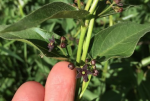
Black swallow-wort is a milkweed vine with tiny, dark purple flowers.

A member of the milkweed family is August’s Weed of the Month. Black swallow-wort (Cynanchum louiseae), also called dog-strangling vine, is a perennial, herbaceous vine that can form large patches and crowd out native vegetation.

It was introduced to North America from southern Europe in the 1800s as an ornamental plant, and in 1864 was recorded escaping from a botanic garden in Massachusetts.

Since its introduction to North America, it has been found invading abandoned farm fields, pastures, and prairies throughout the Eastern and Midwestern United States. Black swallow-wort has twining stems up to six feet long.

It has dark green, glossy foliage and star-shaped, dark purple flowers with a yellow center.

The flowers are only 1/8 inch in size and develop...

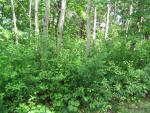
This forest has the invasive shrub common buckthorn invading the understory and would be a good candidate for invasive plant management.

Minnesota is well loved for forested areas – from expansive tree covered landscapes to wooded city lots. While not all forests in Minnesota have invasive species, they are all susceptible.

Invasive plant management tactics may look different depending on the infestation size, location and other factors.

We have the opportunity to contribute to invasive species control & protection of our forested landscapes. Invasive plants commonly found in Minnesota forests vary by region – based on differences in climate throughout the state, the level of forest fragmentation and, largely, the influence that humans have on that particular landscape. Some forest invasive plants grow successfully in shade and can tolerate or thrive in a canopy cover of trees.

Other forest...

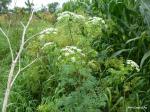
A poison hemlock plant in flower.

Poison hemlock (Conium maculatum) is a toxic member of the carrot family. It can grow to heights of eight feet and has clusters of small white flowers that bloom from May to August.

The leaves are fernlike and the stems have purple spots. All parts of the plant are toxic if ingested. 2017 was an important year for poison hemlock in Minnesota.

Prior to 2017, it was confirmed in isolated pockets of only eight counties. Accurate mapping and reporting led to confirmation of infestations in 17 additional counties.

A rigorous evaluation using a weed risk assessment model, was conducted on poison hemlock by the Noxious Weed Advisory Committee (NWAC).

Press from a subsequent MDA media release also helped increase awareness and interest in the toxicity of this plant...

Contact Us

The Minneota Mascot
Address: 201 N. Jefferson
Minneota, MN 56264

Phone:(507) 872-6492


Site Links